
Sixty Years Old and Still the Best in the Room: Riding Classic BMW Boxers Through Central Italy
- Home
- /
- BLOG
- /
- BIKE STUFF
- /
- SIXTY YEARS OLD AND STILL THE BEST IN THE ROOM: RIDING CLASSIC BMW BOXERS THROUGH CENTRAL ITALY
There are motorcycles, and then there are motorcycles. The kind that make people stop on the sidewalk, lean over, and ask what year it is. The kind where the sound of a kick-start and the first idle of an air-cooled boxer twin tells you immediately that you are not, in any way, aboard ordinary transportation.
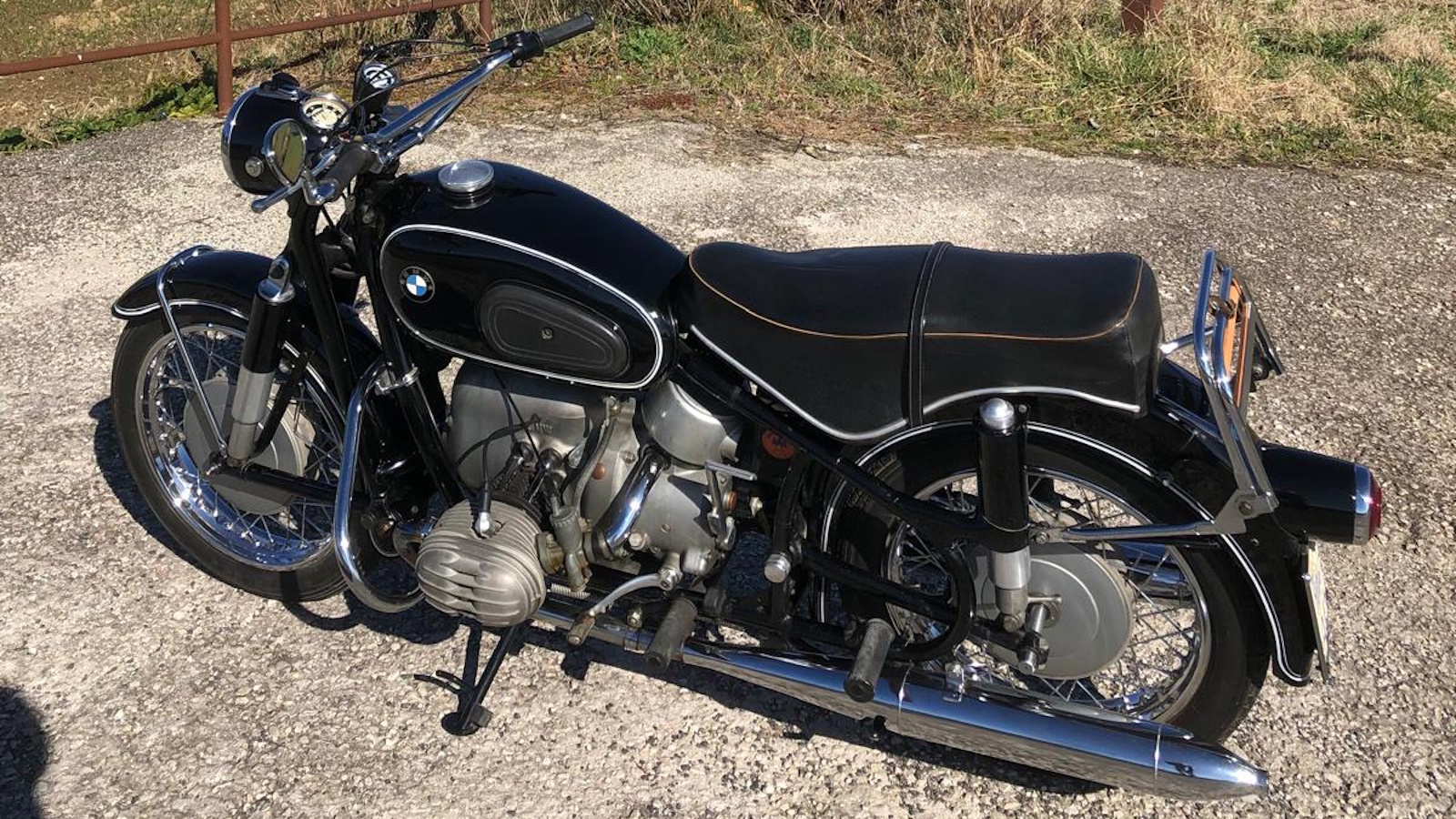
The BMW /2 series — the R50, R60/2, and R69S produced between the mid-1950s and 1969 — belongs firmly in the second category. Blue Strada’s Classic BMW Motorcycle Tour of Tuscany, Italy puts you on four of them, in the Italian Central Apennines, for six days of mountain roads, medieval villages, Umbrian hilltops, and Chianti country. The 2026 date is October 11–19.
This one is special. Let us explain why.
The Motorcycles: A Brief History of Perfection
The BMW /2 series is, in the eyes of many enthusiasts, the finest motorcycle BMW ever made. That is not a casual claim given everything Munich has produced over the intervening decades — but the market tends to agree. The Hagerty valuation guide notes that prime examples of the R69S have more than doubled in value since 2020, with the best specimens now trading at around $50,000. These are no longer just motorcycles — they are blue-chip collectibles that also happen to be a joy to ride.
What makes them so beloved? Start with the engine. The horizontally opposed boxer twin — cylinders protruding on either side above the rider’s feet, crankshaft running front to rear — is BMW’s defining design signature, traced directly back to the R32 of 1923 and continuing in every BMW motorcycle built today. On the /2 bikes, this engine breathes through a magneto ignition independent of the rest of the electrical system, spun up by a polished kickstart lever. Once running, the characteristic gentle torque twist at idle — the whole machine rocking slightly with each combustion cycle — is something you feel as much as hear.
Each model in the series has its own personality:
The 1958 BMW R50 is the smallest-displacement bike in the tour’s stable, a 494cc air-cooled twin producing 26 horsepower in a beautifully balanced package. Introduced in 1955, the R50 was designed as much for sidecar use as solo touring — hence its robust duplex steel frame and famous Earles leading-link front fork, which provides an unusually stable, planted feel at low speed.
The 1968 and 1969 BMW R60/2 are the touring workhorses of the /2 family — 594cc, 30 horsepower, shaft-driven, and legendarily unbreakable. One R60 holds a record that still resonates in adventure motorcycling circles: in 1960–61, Danny Liska rode one from the Arctic Circle in Alaska to Tierra del Fuego in South America — 153,000 kilometers — becoming the first person to complete the journey on a motorcycle. He chose the R60 because it was the most reliable machine available. Decades later, the verdict stands.
The 1967 BMW R69S is the jewel of the collection and arguably the most desirable motorcycle BMW has ever produced. The S designation is significant: where the R69 was the touring version, the R69S was the sporting one — reworked with a 9.5:1 compression ratio, twin 26mm Bing carburettors, a hydraulic steering damper, and 42 horsepower at 7,000 rpm. It was fast enough that the Victorian Police in Australia used it for pursuit work and nicknamed it “Whispering Death” — because you rarely heard it coming until the officer was alongside you. The R69S remained competitive in club racing well into the late 1960s, taking an outright class victory at Virginia International Raceway in September 1968.
All four bikes on this tour are in perfect mechanical condition, fitted with fresh tires and tubes. Each participant rides all four motorcycles during the tour — a rare opportunity to feel the subtle differences between models that aficionados argue about endlessly.
The Man Behind the Machines: Alfredo Massini
The bikes are remarkable. The man who has cared for them is equally so.
Alfredo Massini spent over twenty years running one of Rome’s most respected classic BMW repair shops — the reference point for vintage BMW riders in Rome and Central Italy. He knows these machines at a level most mechanics never reach, understanding not just what breaks and how to fix it, but how each model’s character changes with mileage, with altitude, with temperature. When he sold the Rome shop, he opened a new workshop in the small town of Rieti — which is where the tour collects the bikes, and where Alfredo becomes your tour leader for the seven days that follow.
This is important context. A guided motorcycle tour lives and dies on the quality of the guide, and Alfredo brings two things most guides don’t have simultaneously: mechanical authority over the exact machines you’re riding, and deep local knowledge of roads that most riders — Italian or otherwise — have never found. He is, by all accounts, also simply a very nice person to spend six days with through the mountains.
The Route: Central Italy’s Secret Roads
The tour begins in Rome, with an airport transfer to a hotel in the city center and a Welcome Dinner on the evening of arrival. The next morning, a 90-minute shuttle heads north to Rieti — a Roman-era city sitting at the exact geographical center of Italy, surrounded by the green Apennine foothills. This is where the bikes are waiting.
Rieti and its roads don’t appear in most motorcycle touring guides, which is precisely the point. The Central Apennines — running south from Tuscany through Umbria and Lazio toward Rome — are what adventure riders call a best-kept secret: mountain passes, empty hairpins, ridge roads with views over valleys that look the same as they did in the Renaissance, and virtually none of the tourist traffic you’ll find further north. The SP10 road on Monte Terminillo — not far from Rieti — is described by experienced Central Italy riders as one of the finest motorcycle roads in the country: tight zigzags and sweet curves up a 2,000-meter mountain, with scenery that never fails to astonish.
Day 1 sets the tone: a loop ride from Rieti to the Cascate delle Marmore — the Marmore Falls — one of the most dramatic waterfalls in Europe, originally engineered by the Romans in 271 BC to drain the Velino marshes into the Nera River valley below. The drop is over 160 meters in three tiers. Arriving on a 1960s BMW adds a dimension of time-travel to the experience that is genuinely hard to replicate.
Day 2 takes the tour up into the mountains toward Castelluccio di Norcia — a destination that has no equal in Central Italy and few equivalents anywhere in Europe. Sit with this for a moment: Castelluccio is a medieval village perched at 1,452 meters above sea level in the Monti Sibillini National Park, overlooking the Piano Grande — a vast, flat-bottomed karst plateau that was once the bed of an ancient Apennine lake. The road up is a series of panoramic hairpin switchbacks that suddenly open onto an almost otherworldly view of the plain below. In summer and early autumn, the plateau’s famous lentil fields — holder of Protected Geographical Indication status — bloom in waves of white, purple, yellow, and red. Even in October, as the harvest wraps up and the mountains sharpen in the autumn light, the landscape is extraordinary. This is, without question, one of the most stunning places to ride a motorcycle in all of Italy.
Day 3 transitions the tour across the Apennines toward Siena via the kind of twisty roads that define Central Italian motorcycling: ridge routes, forested climbs, and valley descents with views that stop you mid-sentence. Siena itself is one of the great medieval cities of Europe — the Piazza del Campo and the Duomo among the finest public spaces on the continent — and the tour overnights there for two nights.
Day 4 is a free day in Siena. Walk the Piazza del Campo, visit the Duomo, eat and drink in the cantinas. No motorcycle required.
Day 5 is the Chianti loop — a day’s riding through the rolling hills, vine-covered slopes, and cypress-lined roads of the Chianti Classico region between Siena and Florence. These roads are everything the postcard suggests and more when you’re on a 1960s BMW — unhurried, rhythmic, entirely in keeping with the pace of a landscape that has been producing wine since the Romans.
Day 6 returns the group to Rieti across more mountain roads — a final immersion in the Apennines before the bikes go back. An overnight in Rieti.
Day 7 offers a final morning ride to Leonessa — a mountain town tucked into a high valley in the Lazio Apennines, with the kind of quiet, stepped medieval streets that reward an early morning arrival — before the shuttle returns to Rome and a Farewell Dinner brings the tour to a close.
Day 8: depart or continue. Rome is a very good reason to stay.
What’s Included
- Vintage BMW R50, R60/2, and R69S motorcycles (each rider rides all four)
- Airport limo transfer (Rome Fiumicino to city center hotel)
- Shuttle from Rome to Rieti and return
- 6 nights in comfortable accommodations
- Two dinners including quality wines
- All breakfasts
- Enthusiastic English-speaking tour leader (Alfredo Massini)
- Commemorative apparel
- Primary vehicle insurance with €3,000 max liability
You’ll need to arrange your own flights, lunches, fuel, personal insurance, and any additional meals — and of course, a current motorcycle license.
Who This Tour Is For
If you ride a motorcycle and have any feeling for the machines themselves — not just as transportation but as objects, as mechanical art — this tour is essentially designed for you. You don’t need prior experience on vintage bikes; Alfredo knows these motorcycles inside out and will have you comfortable on them quickly. What you do need is a current motorcycle license, a genuine appetite for mountain roads, and the kind of patience and curiosity that makes a 1960s BMW on a twisting Italian road feel like the exactly right choice.
Pricing starts at €4,276 per person. Only 4 spots remain for October 2026.
Get your personalized quote and book your spot →
More Blue Strada Motorcycle Tours in 2026
The Classic BMW tour isn’t the only way to explore the world on two wheels with Blue Strada this year. Two other motorcycle adventures are still available for 2026:
Motorcycle Portugal — Stunning Atlantic coastlines, dramatic interior landscapes, and some of Europe’s most rewarding roads on two wheels.
Motorcycle Himalayas — Take your riding to the literal top of the world on an unforgettable journey through the highest mountain passes on earth.
Questions? Contact us — we’re happy to talk through the details.
No Responses